Independence and trademark notice. eatonservicecanada.com is not affiliated with Eaton Corporation and is neither sponsored nor endorsed by Eaton. Eaton, Powerware, 9PX, 5PX, ABM and Tripp Lite are trademarks of their respective owners, used here for identification and compatibility reference only.
In a hurry? Table 2 maps each model to its replacement battery cartridge part number. Figure 5 gives the battery-versus-new-UPS decision at a glance. The rest of the paper shows the evidence behind both.
Abstract and intended reader
Every Eaton 9PX and 5PX UPS in service in Canada will need its batteries replaced at least once, and probably two or three times, before the electronics themselves wear out. This white paper is a verified reference for that recurring event. It maps the current 9PX and 5PX G2 models to their internal replacement battery cartridges (the 744-series part numbers), documents the extended battery module (EBM) options and their chaining limits, explains what a realistic replacement cycle looks like in Canadian equipment rooms, and closes with a decision method for the harder question: when a battery quote stops making sense and the money should go to a new UPS instead.
The intended readers are IT managers, system administrators, facility managers and procurement staff who operate one or more Eaton 9PX or 5PX units and must plan or approve battery work. Every part number, voltage, runtime figure and compatibility statement in this paper was verified against Eaton’s published specification sheets, retrieved on 11 July 2026 from Eaton’s official product documentation [1][2][3][4][5][6][7][8][9][10][11][12][13]. Eaton hosts its single-phase UPS documentation on the Tripp Lite domain following its acquisition of Tripp Lite, so those specification-sheet links resolve to tripplite.eaton.com and assets.tripplite.com. Statements that rest on other evidence classes, such as anonymized field observations or manufacturer rules of thumb, are identified as such where they appear.
The decision this paper supports
The paper answers four questions an owner faces in a fixed order. First, what exactly is installed: which family, which model, which DC string. Second, which replacement battery cartridge or EBM part number fits that model, with no substitution guesswork. Third, when the replacement should happen: on what cycle, watching which signals. Fourth, whether replacement is still the right spend at all, or whether the unit’s age and support status mean the budget belongs in a new UPS.
Getting the order right matters because the most expensive battery mistakes are sequence mistakes. Buying batteries for a frame that Eaton no longer supports, sizing an EBM chain that the UPS cannot accept, or condemning healthy electronics because nobody checked the battery date code are all avoidable with the reference material below.
Terms, system boundary and assumptions
A few terms carry this paper. A replacement battery cartridge (RBC) is Eaton’s pre-wired, hot-swappable internal battery assembly, identified by a 744-series part number such as 744-A3121 [12]. An extended battery module (EBM) is a separate chassis of batteries that daisy-chains to the UPS through high-current DC connectors to add runtime [7]. VRLA means valve-regulated lead-acid, the sealed battery chemistry used in the standard versions of both families. ABM is Eaton’s branded battery-management charging method, which uses a three-stage cycle rather than continuous float charging [1]. A DC string is the set of series-connected batteries that establishes the direct-current bus voltage of a given model, for example 180 VDC on a 9PX6K [1].
The system boundary is the single-phase Eaton 9PX and 5PX families as sold in North America, their VRLA cartridges and their EBMs. Three-phase Eaton platforms, the 9SX and legacy 9130 appear only where they affect a service decision. Lithium-ion variants appear as a decision alternative, not as a covered retrofit procedure.
Three assumptions apply throughout. Runtime figures quoted from Eaton specification sheets assume new, fully charged batteries at reference conditions; an aged string delivers less [19]. The published battery life expectation of three to five years is a population statement, not a promise for any single battery [14]. And per-model lifecycle stage assignments in Eaton’s End of Service Life program change over time, so this paper teaches the stage model and directs readers to Eaton’s current table rather than quoting dates that would age in place [15].
The two families: what separates a 5PX from a 9PX
The short answer: the 9PX is an online double-conversion UPS and the 5PX G2 is a line-interactive UPS. A 9PX rebuilds the output waveform continuously and hands the load to battery with zero transfer time, which is what servers and control systems need. A 5PX G2 regulates voltage with automatic voltage regulation and switches to battery when the input goes out of tolerance, which is adequate for network closets and edge equipment [1][4].
The distinction matters to a battery buyer for one practical reason: both families use hot-swappable, pre-wired VRLA cartridges and daisy-chainable EBMs, but the part numbers never cross. A 5PX G2 EBM does not fit a 9PX, and cartridge part numbers are specific to narrow model groups within each family [9][11].
Verified examples from the current North American specification sheets anchor the ranges. In the 9PX family, the 9PX1500RT delivers 1500 VA and 1350 W from a 48 VDC internal string; the 9PX6K delivers 6000 VA and 5400 W at 208 V from a 180 VDC string; and the 9PX11K delivers 11000 VA and 10000 W from a 240 VDC string [1][2][3]. In the 5PX G2 family, the 5PX1500RTG2 and 5PX1500RTNG2 deliver 1440 VA and 1440 W, and the 5PX3000RTG2 delivers 3000 VA and 3000 W; on these G2 models the VA and W ratings are equal, so the full apparent power rating is available as real power [4][5][6]. All models named here are cUL Listed, carry a 3-year limited warranty for the United States and Canada, and are rated for 0 to 40 degrees C operation [1][3][4]. Those 3-year terms apply to the UPS units; replacement battery cartridge and EBM warranties are stated separately on their own sheets. One caution on the examples: Eaton is moving both lines to a G2 generation, so a 9PX6KG2 now exists alongside the plain 9PX6K, and 5PX G2 supersedes the original 5PX. Confirm whether a given unit is the base or G2 version, and read its lifecycle stage, in Eaton’s current End of Service Life table before you commit to parts [15].
| Model | Type | Rating | Internal DC string | Published runtime, full load | Published runtime, half load |
|---|---|---|---|---|---|
| 9PX1500RT | Online double-conversion | 1500 VA / 1350 W | 48 VDC | 5 min at 1350 W | 16 min at 675 W |
| 9PX6K | Online double-conversion | 6000 VA / 5400 W | 180 VDC | 3 min at 5400 W | 8 min at 2700 W |
| 9PX11K | Online double-conversion | 11000 VA / 10000 W | 240 VDC | 3 min at 10000 W | 10 min at 5000 W |
| 5PX1500RTG2 | Line-interactive | 1440 VA / 1440 W | 48 V EBM class | 5 min at 1440 W | 15 min at 720 W |
| 5PX3000RTG2 | Line-interactive | 3000 VA / 3000 W | 72 V EBM class | 3 min at 3000 W | 9 min at 1500 W |
Table 1. Verified model examples from Eaton specification sheets, retrieved 11 July 2026 [1][2][3][4][5]. Runtime values assume new, fully charged batteries. The 5PX G2 specification sheets do not publish an internal DC-bus voltage; the value shown for the two 5PX rows is the nominal voltage of the matching EBM class, not a stated UPS internal-string figure.
Those short full-load runtimes are not a defect. Eaton sizes internal strings for orderly shutdown or generator pickup, and sells runtime separately through EBMs. An owner who needs thirty minutes of autonomy buys it as modules, not as a bigger UPS.
One relationship worth knowing when stocking parts: the 9PX and 9SX share much of the same replacement cartridge and EBM ecosystem on matching ratings, an observation recorded in our Eaton product-line service reference [21] rather than on a single specification sheet, so confirm the exact cartridge for a 9SX before ordering against a 9PX list.
Which replacement battery cartridge fits which unit
The rule that governs this section comes from the safety listing, not from marketing. UL guidance for UPS equipment is that replacement batteries must be of a type identified on the equipment or in the product instructions; substituting an unlisted type is a modification of listed equipment whose continued certification has not been established [17]. In practice that means the 744-series part number, or the exact electrical and mechanical equivalent the instructions permit, is the specification.
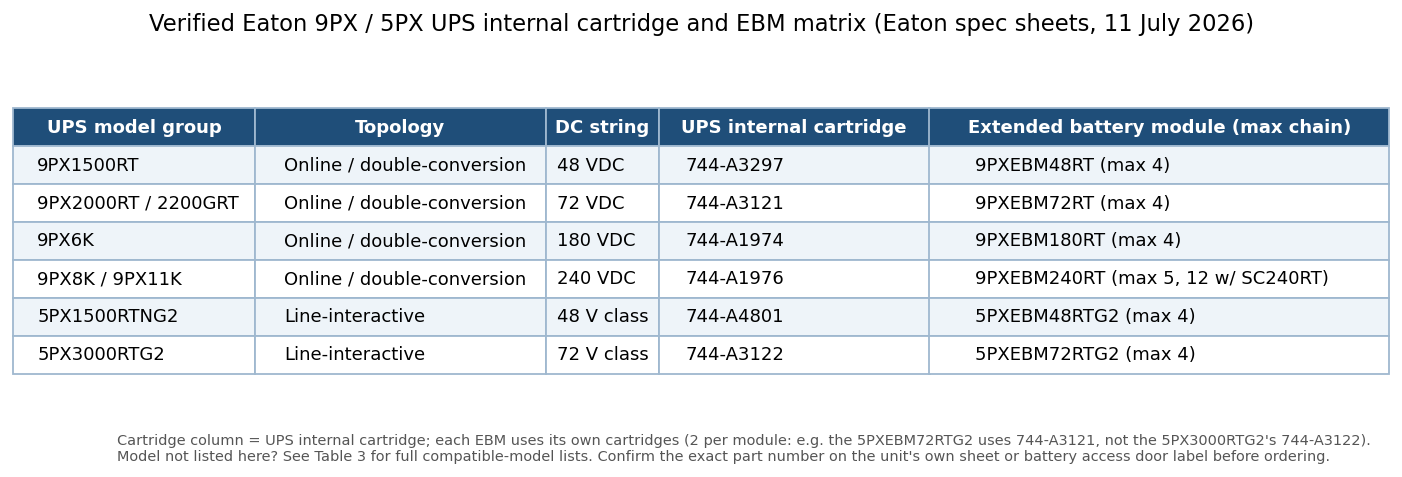
Two cartridges were verified in full for this paper. The 744-A3121 fits the 9PX2000RT, 9PX2000RTN and 9PX2200GRT, along with their compatible Tripp Lite SmartOnline counterparts (SU2200RTXLCD2UTAA, and the 2023 redesigns of SU2200RTXLCD2U, SU2200RTXLCDN and SUINT2200LCD2U), and it is also the internal cartridge of the BP72RT, BP72RT2UTAA and 9PXEBM72RT battery modules [12][9]. The same 744-A3121 is the cartridge inside the 5PX G2 72 V module, the 5PXEBM72RTG2, at two cartridges per module [20]. The 744-A1976 fits the 9PX8K group (9PX8K, 9PX8KHW, 9PX8KPM, 9PX8KTF5) and the 9PX11K group (9PX11K, 9PX11KHW, 9PX11KPM, 9PX11KTF11, 9PX11KTF11M, 9PX11KTF5), and it is the cartridge of the 9PXEBM240RT [13][7].
Model specification sheets identify the remaining cartridges in the same way. The 9PX1500RT sheet lists cartridge 744-A3297, one per UPS [2]. The 9PX6K sheet lists cartridge 744-A1974, one per UPS [1]. The 5PX1500RTNG2 sheet lists its internal cartridge 744-A4801 [6], and the 5PX3000RTG2 sheet lists its internal cartridge 744-A3122 [5]. Note that the 5PX3000RTG2 and its matching 5PXEBM72RTG2 module do not share a cartridge: the UPS takes 744-A3122, while the module takes two 744-A3121 cartridges [5][20]. When a model is not in this paper, its current specification sheet or the label inside the battery access door carries the same information; the part number printed there wins over any list, including this one.
Cartridge counts follow a simple published pattern. The verified 1 to 6 kVA models take one cartridge per UPS; the 9PX8K and 9PX11K groups take two; and every EBM in this paper takes two cartridges when its batteries are replaced [1][2][3][7][8][9][10][11]. A full refresh of a UPS plus EBM stack therefore adds up quickly: a 9PX6K with two EBMs needs five cartridges (one plus two per module), and a 9PX11K with a full chain of five EBMs needs twelve. Quote battery work per stack, not per UPS.
All the cartridges named here are sealed VRLA assemblies that are hot-swappable: they can be changed without dropping the connected load. The qualification belongs beside the convenience: during the swap the load is running on raw utility with no battery reserve, so schedule the work in a low-risk window [12][13]. Compatible 9PX replacement packs are stocked domestically; Eaton 9PX replacement battery packs sold in Canada list the supported UPS model and string voltage on each product page, which is the same match-by-part-number discipline this section describes.
| Cartridge | Fits UPS models | Fits battery modules | Cartridges per UPS |
|---|---|---|---|
| 744-A3297 | 9PX1500RT (per its specification sheet) | 9PX 1500 VA class EBM, per its sheet | 1 |
| 744-A3121 | 9PX2000RT, 9PX2000RTN, 9PX2200GRT, plus listed Tripp Lite SmartOnline counterparts | BP72RT, BP72RT2UTAA, 9PXEBM72RT, 5PXEBM72RTG2 (2 per EBM) | see model sheet |
| 744-A1974 | 9PX6K (per its specification sheet; 3 to 6 kVA cartridge listing) | per matching EBM sheet | 1 |
| 744-A1976 | 9PX8K group, 9PX11K group | 9PXEBM240RT (2 per EBM) | 2 |
| 744-A3122 | 5PX3000RTG2 (per its specification sheet) | not the 5PXEBM72RTG2 cartridge (that module uses 744-A3121) | 1 |
| 744-A4801 | 5PX1500RTNG2 (per its specification sheet) | per matching EBM sheet | 1 |
Table 2. Verified cartridge compatibility, a partial excerpt from Eaton cartridge and model specification sheets retrieved 11 July 2026 [1][2][5][6][7][9][12][13][20]. It covers the models named in this paper; confirm any model not shown, and the non-N 5PX1500RTG2 whose sheet does not publish a cartridge number, on the unit’s own sheet or battery door label before ordering.
Extended battery modules: what an EBM is and how far a chain can go
An EBM is a chassis of VRLA batteries with no electronics of its own beyond monitoring connections. It plugs into the UPS DC bus through heavy-gauge cabling and high-current connectors, and additional EBMs daisy-chain behind the first through a pass-through connector. The UPS detects the added strings and recalculates its runtime estimate. Runtime is the only thing an EBM adds: output capacity stays exactly what the UPS nameplate says, and every added string increases recharge demand and available DC fault energy, which is why the chain limits below are hard limits from the manufacturer, not suggestions [7][19].
The verified EBM matrix for the two families:
| EBM | DC voltage | Rack height | Compatible units (per specification sheet) | Maximum chain |
|---|---|---|---|---|
| 9PXEBM48RT | 48 VDC | 2U | 9PX1000GRT, 9PX1500RT, 9PX1500RTN, 9PX1500GRT | 4 |
| 9PXEBM72RT | 72 VDC | 2U | 9PX2000RT, 9PX2000RTN, 9PX2200GRT, 9PX3000RT, 9PX3000RTN, 9PX3000GRT, 9PX3000GLRT | 4 |
| 9PXEBM180RT | 180 VDC | 3U | 9PX3K3UN variants, 9PX5K group, 9PX6K group | 4 |
| 9PXEBM240RT | 240 VDC | 3U | 9PX8K, 9PX8KHW, 9PX8KTF5, 9PX11K, 9PX11KHW, 9PX11KTF11, 9PX11KTF11M, 9PX11KTF5 | 5, or 12 with SC240RT supercharger |
| 5PXEBM48RTG2 | 48 VDC | 2U | 5PX1000RTG2, 5PX1000RTNG2, 5PX1500RTG2, 5PX1500RTNG2, 5PX1500HRTG2 | 4 |
| 5PXEBM72RTG2 | 72 VDC | 2U | 5PX2000RTG2, 5PX2000RTNG2, 5PX2200HRTG2, 5PX3000RTG2, 5PX3000RTNG2, 5PX3000HRTG2, 5PX3000HRTNG2 | 4 |
Table 3. Verified EBM compatibility and chaining limits from Eaton specification sheets retrieved 11 July 2026 [7][8][9][10][11][20]. Each EBM here takes two 744-series cartridges when its own batteries are replaced.
Two current-catalog details deserve attention. The 2026 specification sheet for a new 9PX6K lists its expansion path as up to four EBMs using the newer 9PXEBM180RTG2 module together with a CBLADAPT180RT adapter cable, while the original 9PXEBM180RT remains the module documented for the existing 9PX5K and 9PX6K installed base [1][8]. And on the 240 V bus, the chain limit rises from five modules to twelve only when the separately sold SC240RT supercharger module manages the recharge load [7]. Both details show why the specification sheet of the exact unit in front of you, at the revision current when you order, is the document of record.
Weight is the site-planning constraint owners forget. A single 9PXEBM240RT weighs 64.86 kg (143 lb) and needs 3U of rack space and 31 inches of rack depth [7]. A five-module chain adds more than 320 kg to the rack plus the UPS itself, which can matter on raised floors and in older buildings.
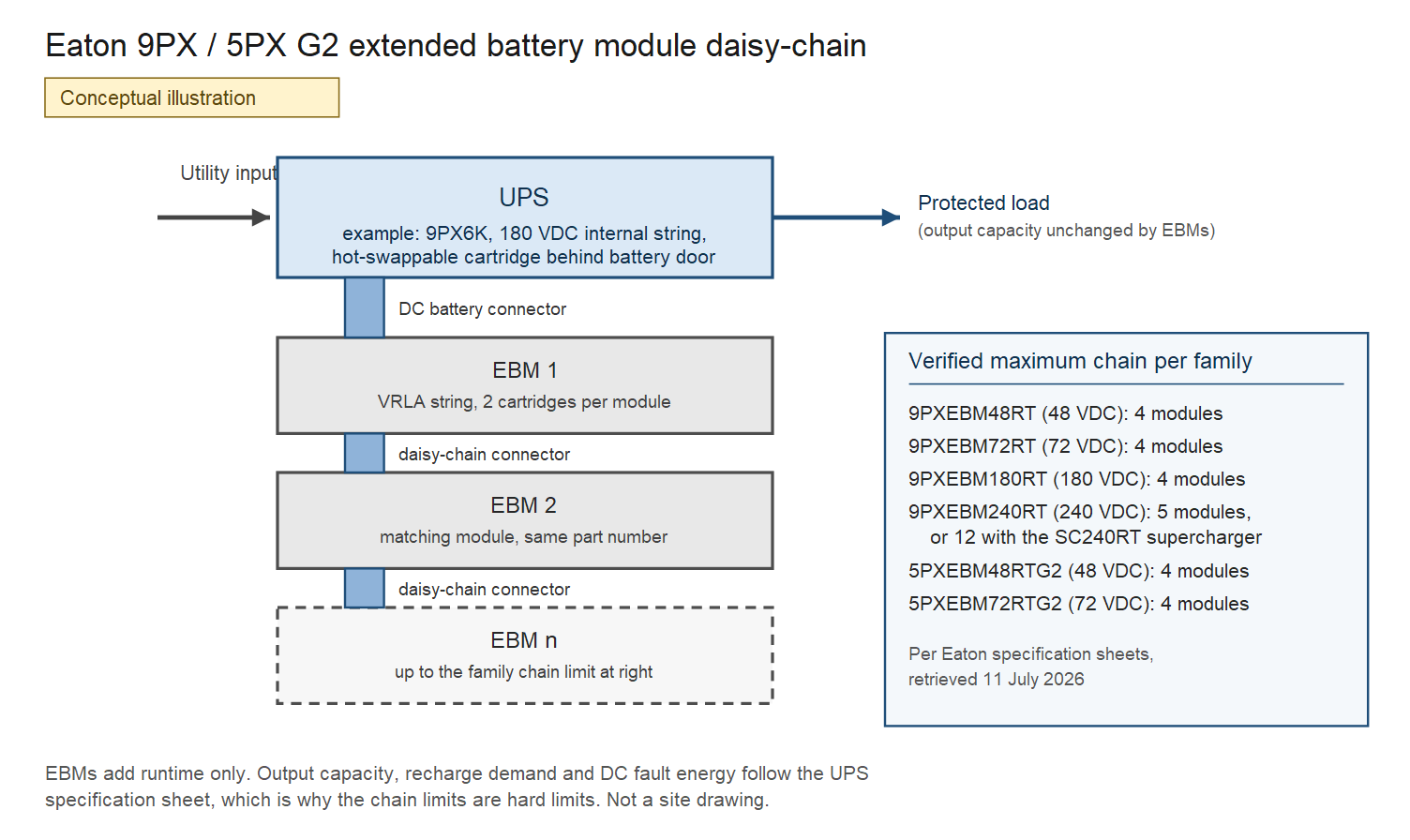
A last EBM caution: published runtime tables assume the whole chain is healthy. A chain in which one module has aged strings will not deliver the table value, and the UPS runtime estimate will drift down as ABM learns the real capacity. Autonomy that carries a contractual or life-safety obligation is proven with a controlled discharge test against a defined load, not with a chart [19].
How long the batteries last: replacement cycles for Canadian rooms
Eaton’s published expectation is that most sealed lead-acid UPS batteries last three to five years, with the real figure driven by how often and how deeply they discharge, the room temperature they live at, and how well they are maintained [14]. Eaton’s specification sheets add the manufacturer’s own life-extension claim: ABM three-stage charging, standard on both families, is stated by Eaton to extend battery service life by 50 percent and to provide advance warning when replacement is approaching [1][7]. Treat the three to five years as the planning band and the ABM claim as the reason many well-kept units reach the top of that band.
Temperature is the strongest lever a Canadian owner controls. Battery manufacturers publish a long-standing rule of thumb that VRLA float life halves for sustained operation roughly every 8 to 10 degrees C above the 25 degree C reference [19]. Applied to the published band, a room that sits near 35 degrees C can compress a three to five year expectation to roughly 1.5 to 2.5 years. The arithmetic is planning guidance, not a site prediction, and family-specific manufacturer data governs any real design decision; but the direction is unambiguous, and a warm server closet above a boiler room in February is not a rare Canadian configuration.
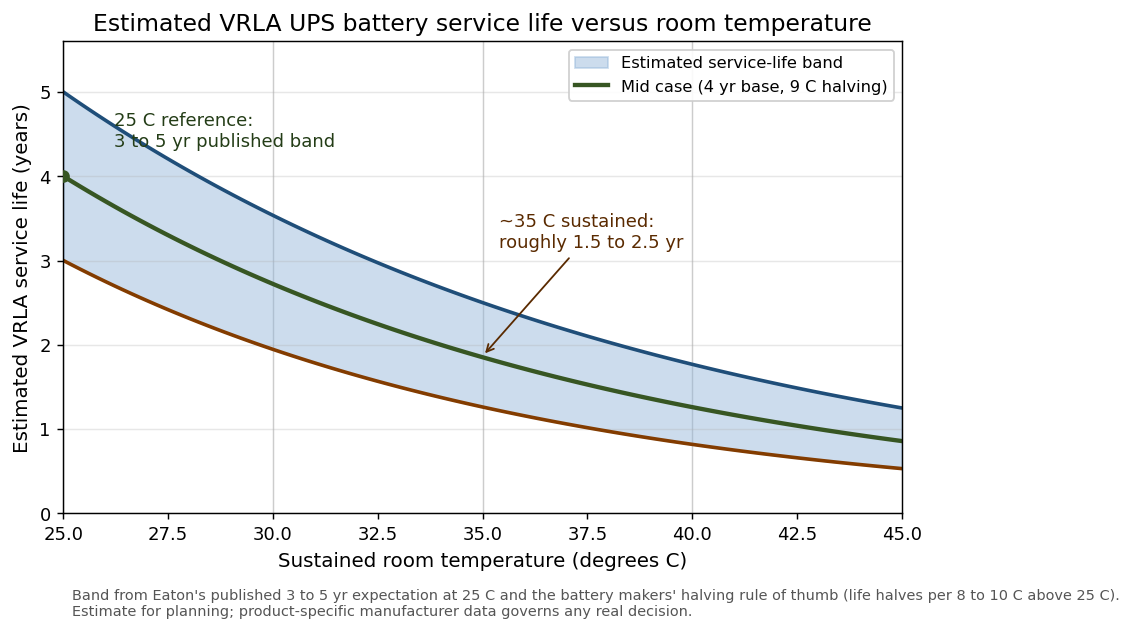
Put the two facts together and the replacement budget writes itself. Over a ten to twelve year electronics planning life (a servicer planning convention, not an Eaton-published figure), a battery set that lasts three to five years means roughly two to four full battery replacements per frame. The calculation is transparent: divide the planning life by the battery life and round down, evaluated at both ends of the ranges, so 10 divided by 5 gives 2 and 12 divided by 3 gives 4. A cool, well-kept room lands near the low end at 2 to 3 events. A warm room compounds toward the high end: because sustained operation near 35 degrees C cuts battery life below the three-year floor to roughly 1.5 to 2.5 years, as the temperature chart above shows, a hot room can reach four replacements or more across the same frame life. An owner who books one cartridge set per UPS into the budget every three to four years, plus two cartridge sets per EBM on the same cycle, will rarely be surprised.
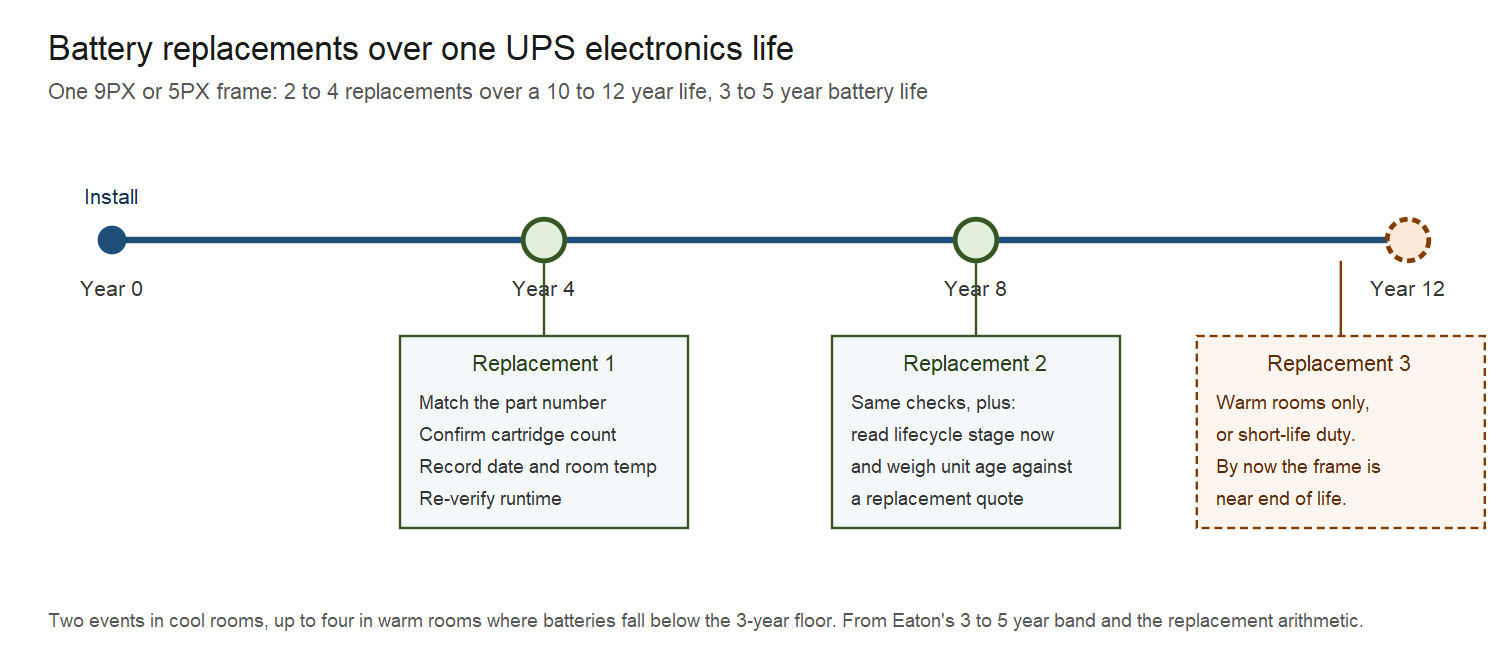
Watch three signals between scheduled replacements. A battery fault or failed self-test that repeats after a 48-hour recharge is an end-of-life indicator, not a nuisance alarm [19]. A runtime estimate that has visibly shortened against the unit’s own history says capacity is fading even if no alarm has fired. A short self-test, useful as it is, does not prove autonomy; and an ohmic reading identifies a suspect block against a baseline rather than converting into minutes of runtime [19].
Field patterns from Canadian service work
The service organization behind this site, our service network, distills its Eaton and multi-brand UPS work into anonymized engineering patterns; roughly 450 technical responses from 2025 and 2026 feed the library these three patterns come from [18].
Pattern one: rule out the battery before condemning the electronics. On aged units presenting a fault, the first question a technician asks is when the batteries were last changed, because a large share of end-of-life service calls trace to an exhausted string rather than failed power electronics. A battery date code is cheaper to check than an inverter is to replace.
Pattern two: treat monitoring alerts as decisions, not events. The pattern above for depleted-battery alerts extends to the whole alarm vocabulary: an alarm that maps to a battery cause on a unit past year three of its battery life is a replacement conversation, and waiting for the hard fault costs the runtime margin the UPS was bought for.
Pattern three: surface stock and lead time in the first conversation. Replacement cartridges for common Eaton single-phase strings are fast-moving inventory, and an emergency swap cannot wait for a factory lead time. Asking whether the parts are on a Canadian shelf is a legitimate first question to any battery vendor, and a supplier who answers it unprompted is telling you something about their operations.
Failure modes, limitations and safety boundaries
VRLA cartridges fail in predictable ways: capacity fade with age, internal resistance rise, dry-out under heat, and occasionally a swollen or open block that takes the string down. The failure that surprises owners is silent capacity fade, because the UPS passes brief self-tests while real autonomy has fallen well below the nameplate chart. That is why the replacement cycle above is driven by age and signals, not by waiting for a fault [14][19].
The limitations of this paper’s data are worth stating plainly. Specification values were verified on 11 July 2026 against the model revisions Eaton published then; Eaton revises sheets, and the sheet current at your order date governs. Runtime figures are new-battery reference values. The three to five year life and the temperature halving rule are population-level expectations. And per-model lifecycle stage assignments cited in the next section move as Eaton updates its End of Service Life table [15].
Safety boundaries are not negotiable. A UPS battery string stores lethal energy even with the unit switched off, and the DC connectors on EBM cabling carry high fault current. Hot-swap cartridge work through the battery access door is designed for trained users following the manual; anything beyond it, including EBM chain changes and any work on the 180 V and 240 V strings, belongs to qualified service personnel with insulated tools and a lockout procedure. Spent VRLA batteries are hazardous waste in every province and go to a lead-acid recycling stream, not to general disposal [19]. Finally, chemistry substitution is out of scope for field work: converting a VRLA unit to lithium-ion is an equipment modification governed by the UL listing rules cited earlier, and it is done through Eaton’s supported lithium products or not at all [16][17].
Battery or new UPS: the service decision
The decision framework is Eaton’s own lifecycle program read with a servicer’s eyes. Eaton manages support through a published End of Service Life model with four stages: Active, with full support; Mature, where support continues on a best-efforts basis and parts may be limited; Retired, where new service contracts are no longer sold but time-and-material, preventive and battery work may still be possible; and End of Service Life or Obsolete, where no service or parts exist [15]. The same master table translates legacy identities: it maps the 9130, and other Powerware-badged predecessors, to their current 9PX replacement paths [15]. Stage assignments in that table shift with market conditions, so the working method is to read the stage for your exact model in Eaton’s current table, then apply the rules below. If you cannot reach the table, search the model number or “Eaton EOSL master table” on eaton.com support.
The rules follow from what each stage makes possible. On an Active or Mature unit, batteries are a sound investment: the electronics have a support path, and a cartridge set buys three to five more years of protection. On a Retired unit, a battery set can be a deliberate bridge: it keeps the load protected while a replacement is budgeted, and it should be sold and bought explicitly as a bridge. Age adds a second axis inside the supported stages: a unit past roughly eight to ten years carries aging DC-bus capacitors and fans, so a large battery spend on old electronics can be poor value even when parts remain available, and the honest comparison is a battery set plus expected repairs against a current 9PX or 5PX G2 with a fresh 3-year warranty [15][19].
| Lifecycle stage (per Eaton’s current table) | Battery investment | Right conversation |
|---|---|---|
| Active | Yes, on the normal cycle | Preventive maintenance schedule |
| Mature | Yes, with a replacement plan started | Budget timing for the successor model |
| Retired | As an explicit bridge only | Replacement quote alongside the battery quote |
| Obsolete or End of Service Life | Only with written unsupported-electronics notice | New UPS, with the old frame decommissioned |
Table 4. Battery-or-UPS decision by lifecycle stage. Stage definitions from Eaton’s End of Service Life program [15]; investment rules are servicer guidance from field practice [18].

Lithium-ion changes the arithmetic for some sites rather than the framework. Eaton states an 8 to 10 year design life for the LiFePO4 batteries in its lithium 9PX variants, with an integrated battery management system, and lithium EBM counterparts such as the 9PXEBM72RT-L exist for the matching lithium units [16]. That life figure comes from Eaton’s lithium literature, which could not be re-verified live on 11 July 2026, so treat it as an Eaton design claim to confirm against current Eaton documentation rather than a figure this paper independently verified. On a new purchase where mid-life battery replacements are costly to perform, the lithium variant may remove one or two replacement events from the plan; the price premium and model availability for a given rating need current quotes.
On-site work is delivered by a team that performs Eaton and Powerware UPS maintenance across Canada, including battery condition assessment and end-of-life planning on 9PX and 5PX fleets. When the decision above needs site data rather than a table, that is the practical next step.
Decision checklist
- Read the exact model designation from the nameplate, not the family name from memory.
- Pull the current Eaton specification sheet for that model and note the cartridge part number and the cartridge count.
- Check the lifecycle stage for the model in Eaton’s current End of Service Life table [15]; if you cannot reach it, search the model number on eaton.com support.
- If that lifecycle stage is Retired or worse, price a replacement unit before approving battery work, and put the unsupported-electronics notice in writing on Obsolete frames.
- Record the battery install date and room temperature; plan the next replacement at three to five years, sooner in warm rooms [14].
- For runtime changes, confirm the EBM model and chain limit on the specification sheet and re-verify autonomy with a controlled test after installation [7][19].
- Buy cartridges by part number from a supplier who can state Canadian stock and lead time in the first reply.
- Book the hot-swap in a low-risk window, because the load runs without battery protection during the swap [12].
Sources
- [1] Eaton, 9PX6K specification sheet (6000 VA online double-conversion UPS). https://assets.tripplite.com/product-pdfs/en/9px6k.pdf (retrieved 11 July 2026)
- [2] Eaton, 9PX1500RT specification sheet. https://assets.tripplite.com/product-pdfs/en/9px1500rt.pdf (retrieved 11 July 2026)
- [3] Eaton, 9PX11K specification sheet. https://assets.tripplite.com/product-pdfs/en/9px11k.pdf (retrieved 11 July 2026)
- [4] Eaton, 5PX1500RTG2 specification sheet. https://assets.tripplite.com/product-pdfs/en/5px1500rtg2.pdf (retrieved 11 July 2026)
- [5] Eaton, 5PX3000RTG2 specification sheet. https://assets.tripplite.com/product-pdfs/en/5px3000rtg2.pdf (retrieved 11 July 2026)
- [6] Eaton, 5PX1500RTNG2 specification sheet. https://assets.tripplite.com/product-pdfs/en/5px1500rtng2.pdf (retrieved 11 July 2026)
- [7] Eaton, 9PXEBM240RT specification sheet (240 V extended battery module). https://assets.tripplite.com/product-pdfs/en/9pxebm240rt.pdf (retrieved 11 July 2026)
- [8] Eaton, 9PXEBM180RT specification sheet. https://assets.tripplite.com/product-pdfs/en/9pxebm180rt.pdf (retrieved 11 July 2026)
- [9] Eaton, 9PXEBM72RT specification sheet. https://assets.tripplite.com/product-pdfs/en/9pxebm72rt.pdf (retrieved 11 July 2026)
- [10] Eaton, 9PXEBM48RT specification sheet. https://assets.tripplite.com/product-pdfs/en/9pxebm48rt.pdf (retrieved 11 July 2026)
- [11] Eaton, 5PXEBM48RTG2 specification sheet. https://assets.tripplite.com/product-pdfs/en/5pxebm48rtg2.pdf (retrieved 11 July 2026)
- [12] Eaton, 744-A3121 replacement battery cartridge specification sheet. https://assets.tripplite.com/product-pdfs/en/744a3121.pdf (retrieved 11 July 2026)
- [13] Eaton, 744-A1976 replacement battery cartridge specification sheet. https://assets.tripplite.com/product-pdfs/en/744a1976.pdf (retrieved 11 July 2026)
- [14] Eaton, Replacement UPS batteries: buying and installing. https://tripplite.eaton.com/products/replacement-ups-batteries-explained (retrieved 11 July 2026)
- [15] Eaton, UPS End of Service Life (EOSL) master table, publication PL161010EN. https://www.eaton.com/content/dam/eaton/products/backup-power-ups-surge-it-power-distribution/backup-power-ups/services-resources/eaton-end-of-service-life-master-table-us-pl161010en.pdf (recorded reference; confirm the current revision on eaton.com)
- [16] Eaton, 9PX lithium-ion UPS brochure, publication BR153145EN (eaton.com; recorded reference for the lithium design-life figures, not re-verified live on 11 July 2026)
- [17] UL Solutions, Uninterruptible power supply (UPS) system: retrofitting or replacing with new batteries. https://www.ul.com/news/uninterruptible-power-supply-ups-system-retrofittingreplacing-new-batteries (verified live, retrieved 11 July 2026)
- [18] our service network, internal field case library of anonymized UPS engineering patterns, 2025 to 2026 (unpublished; approximately 450 technical responses)
- [19] our service network, internal UPS battery engineering references: battery selection and retrofit safety; battery sizing and runtime validation; battery testing and condition assessment (unpublished, citing UL, IEEE and battery manufacturer primary sources)
- [20] Eaton, 5PXEBM72RTG2 specification sheet (72 V extended battery module). https://assets.tripplite.com/product-pdfs/en/5pxebm72rtg2.pdf (retrieved 11 July 2026)
- [21] our service network, internal Eaton UPS product-line, lifecycle and service reference (unpublished; synthesizes Eaton primary sources)
Trademarks: Eaton, Powerware, 9PX, 5PX, ABM and Tripp Lite are trademarks of their respective owners. This document and eatonservicecanada.com carry no Eaton affiliation, sponsorship, or endorsement.